Fencing Forward has operated on a simple observation: fencing changes lives, but too few families ever get the chance to find that out. We built our entire mission around extending the sport’s developmental benefits and its financial barriers. What we didn’t have, until now, was national data to prove it.
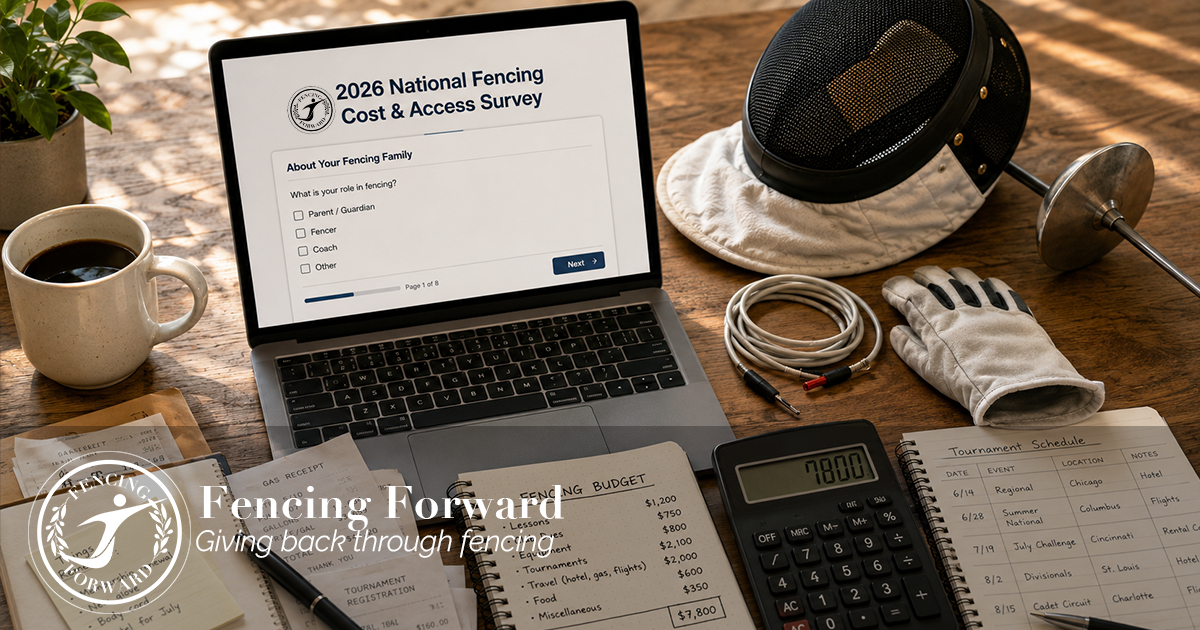
That’s why we conducted the first-ever national survey focused specifically on fencing participation costs and access barriers. Major studies on youth sports costs from organizations like the Aspen Institute, Good Sports, and MassMutual have never included fencing at all. We set out to understand more, surveying active fencers, former fencers, and families who have never fenced but expressed interest in the sport, across income levels, regions, and competitive levels.
What we found confirms exactly why Fencing Forward exists.
The Headline Numbers
The average family with an active fencer spends over $23,000 per year on the sport, with some families reporting costs as high as $84,000 annually. Nearly half of active fencers have already reduced their participation because of cost, even though our respondent pool skewed toward higher-income households than the general population. That means the real scope of this problem is almost certainly larger than what we captured.
Perhaps most surprising: travel, not equipment, is the dominant cost driver. Hotels and airfare alone average nearly $8,600 per year per family, more than club dues, private lessons, and gear combined. Any conversation about making fencing more affordable has to start with the competitive travel circuit itself.
Fencing Works, But Only If You Can Afford It
The survey also gave us our strongest evidence yet that fencing is a genuine tool for mental health and emotional development, not just a recreational activity. Fencers report meaningfully better mental health, emotional control, and social connection while active in the sport, and feel measurably worse across nearly every well-being category when away from it. Sixty-one percent of active fencers cite “mental focus and discipline” as a reason they fence, ranking well ahead of college applications or academic benefits.
We also found a notable signal around neurodivergence: 23% of respondents reported ADHD/ADD, a rate notably higher than general youth population estimates. This is an area we believe deserves further study and could shape future programming.
And yet, affordability was rated the single lowest-satisfaction category in the entire survey, 2.26 out of 5, even as families rated coaching and club quality highly. Families love this sport. They are being priced out of it anyway.
An Access Problem, Not a Demand Problem
Fencing has no meaningful public school infrastructure. Unlike basketball, soccer, or track, there is no free or low-cost public entry point, families must buy their way in from day one. Families who have never tried fencing overwhelmingly cited cost and lack of information, not lack of interest, as what kept them out.
Why This Matters for Fencing Forward
This data validates the model we’ve built our organization around, and it sharpens our priorities going forward. We’re using these findings to focus our advocacy and fundraising on the areas that matter most: travel and competition-fee relief, scholarship-for-service models like the ones already working for some families in our survey, and partnerships that could bring fencing into public schools for the first time.
We’re proud to share the full report, attached here, as the first national evidence base of its kind for our sport. We believe it makes the case clearly: the developmental value of fencing is real, it’s valued by the families who experience it, and right now it’s only available to a narrow slice of American youth. Closing that gap is exactly what Fencing Forward exists to do, and we’re grateful to everyone who took the time to share their experience and help us build the case.